
How to Choose Sealing Mats for Global Sourcing
Global sourcing makes Sealing Mats a technical purchasing decision, not merely a price comparison. A mat that looks suitable on a supplier’s website may soften under heat, shrink after compression, or leak around a flange. Small differences matter.
Industry reports show why this category deserves careful evaluation. MarketsandMarkets’ reports on gaskets and seals consistently identify automotive, chemical processing, energy, and industrial equipment as major demand sectors. These applications require controlled sealing performance across temperature, pressure, vibration, and chemical exposure. The International Organization for Standardization also emphasizes material consistency, dimensional control, and traceability through standards such as ISO 9001 and ISO 3601. Standards help. They do not replace testing.
A reliable sourcing process begins with the operating environment. Record the media, temperature range, pressure, flange design, compression load, and expected service life. Then compare materials such as EPDM, NBR, silicone, PTFE, and graphite against those conditions. A supplier should provide test reports, batch records, tolerances, and clear inspection criteria. Ask for samples.
Do not trust appearance alone.
Procurement teams should also examine tooling accuracy, packaging, minimum order quantities, and replacement lead times. The World Bank’s Logistics Performance Index 2023 highlights how customs, transport reliability, and shipment tracking influence international supply performance. One overlooked delay can erase a low unit price.
The difficult part is admitting that no material performs best everywhere. A cheaper Sealing Mats option may reduce initial cost, yet increase maintenance risk. This guide explains how to assess suppliers, specifications, certifications, and total ownership costs with practical judgment. Mistakes remain possible, so every decision should be tested and documented.
What Sealing Mats Are and How They Work
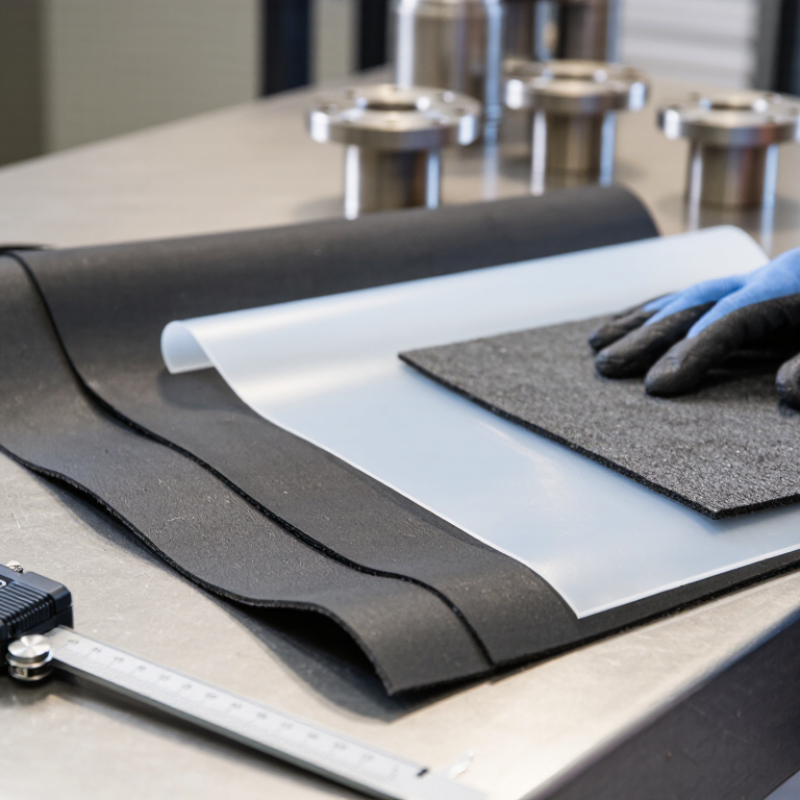
A sealing mat is a compressible layer placed between two mating surfaces. It helps prevent liquids, gases, dust, or pressure from escaping through small gaps. Unlike a rigid metal plate, the mat can adapt to minor surface irregularities.
Its performance depends on controlled compression. Bolts press the mat against a flange, while the material fills scratches and uneven areas. Rubber-based mats suit many water and air applications. Fiber, graphite, and PTFE-based materials can handle different temperatures or chemicals. The choice must match the actual service conditions, not only the product description.
In field inspections, I check the medium, temperature, pressure, flange condition, and bolt pattern. A thick mat is not automatically safer. Excessive thickness may creep, while insufficient compression can cause leakage. I have seen clean-looking flanges fail because their surfaces were slightly warped. Small details matter.
Global sourcing adds another layer of control. Request material data, compression limits, temperature ranges, and test records before comparing prices. Confirm dimensions in a shared unit system. Ask how batches are identified and packed for transport. Moisture, bending, and poor storage can damage some materials before installation. A supplier may provide excellent samples, yet production consistency still needs verification. This is where my own assumption can fail: one successful trial does not prove long-term reliability. Sampling, inspection, and installation records provide stronger evidence.
How to Choose Sealing Mats for Global Sourcing - What Sealing Mats Are and How They Work
| Sealing Mat Type | How It Seals | Typical Temperature Range | Typical Pressure Capability | Common Fluid Compatibility | Common Applications | Key Sourcing Checks |
|---|---|---|---|---|---|---|
| Compressed Non-Asbestos Fiber | Compressible fiber and elastomer matrix fill surface irregularities between bolted flanges. | Approximately -40 to 350°C, depending on grade and binder. | Suitable for low-to-medium pressure service; confirm the manufacturer’s pressure-temperature chart. | Water, air, oils, fuels, and selected chemicals; compatibility varies significantly by binder. | Pipe flanges, pumps, compressors, water systems, and general industrial equipment. | Fiber type, binder, thickness recovery, blowout resistance, and relevant flange standard. |
| Expanded PTFE | Soft, chemically resistant PTFE conforms to flange imperfections under compression. | Approximately -200 to 260°C for many grades. | Low-to-medium pressure service; pressure depends on density, thickness, and flange loading. | Broad chemical resistance, including many acids, bases, solvents, and process fluids. | Chemical processing, pharmaceutical equipment, food-processing systems, and fragile flanges. | Chemical compatibility, creep resistance, food-contact requirements, thickness, and cleanability. |
| Graphite Sheet | Layered graphite compresses and adapts to uneven surfaces while maintaining sealing under heat. | Approximately -200 to 450°C in oxidizing service; higher temperatures may be possible in non-oxidizing conditions. | Medium-to-high pressure service when correctly specified and installed. | Steam, hydrocarbons, oils, and many chemical media; oxidizing environments require special evaluation. | Steam lines, thermal equipment, valves, heat exchangers, and high-temperature piping. | Oxidation resistance, filler or reinforcement, density, handling strength, and operating atmosphere. |
| Rubber Sheet | Elastic material creates contact pressure and compensates for minor movement or surface irregularities. | Commonly about -40 to 120°C, depending on rubber family. | Generally low-to-medium pressure; use only within the specified temperature and compression limits. | Water, air, oils, fuels, or chemicals depending on EPDM, NBR, silicone, FKM, or other formulation. | Covers, tanks, sanitary equipment, low-pressure flanges, and enclosure seals. | Rubber polymer, hardness, elongation, compression set, media compatibility, and aging resistance. |
| Metal-Jacketed Mat | A soft filler is enclosed by a metal jacket, combining conformability with mechanical protection. | Often suitable for approximately -200 to 500°C, subject to metal and filler selection. | Medium-to-high pressure service with adequate bolt load and flange alignment. | Steam, gases, oils, fuels, and process chemicals; jacket material must match the fluid. | Heat exchangers, pressure vessels, exhaust systems, and high-temperature flanges. | Jacket metal, filler type, dimensions, weld quality, handling damage, and minimum seating stress. |
| Spiral-Wound Mat | Alternating metal winding and soft filler form a resilient seal that tolerates thermal cycling. | Commonly used from cryogenic conditions to approximately 500°C, depending on materials. | Medium-to-high pressure service; design class, winding density, and inner or outer rings are important. | Steam, hydrocarbons, gases, and many process fluids when winding and filler are correctly selected. | Refineries, chemical plants, power generation, pipelines, and pressure equipment. | Winding material, filler, centering ring, dimensions, pressure class, and required bolt load. |
| Metal Ring Mat | A precisely machined metal ring seals by controlled plastic deformation or line contact in a machined groove. | Often suitable for approximately -200 to 600°C or more, depending on alloy and service. | High-pressure and high-temperature applications when the groove and ring are correctly matched. | High-pressure gas, oil, steam, and aggressive process fluids; alloy selection is critical. | Oil and gas equipment, pressure vessels, high-pressure valves, and critical piping joints. | Ring geometry, material hardness, surface finish, groove dimensions, traceability, and nondestructive testing. |